Central Florida Water Quality: A Local Guide
Central Florida water quality depends on the utility, service area, and plumbing serving your home. Orange, Seminole, and Lake County do not share one drinking-water report. Start with your water bill and the correct Consumer Confidence Report, then use home testing to investigate hardness, taste, odor, or specific concerns.
Published November 7, 2026 · Shield Water Solutions
Last reviewed 2026-11-07 · By the Shield Water Solutions team
Quick facts
| Topic | What is known |
|---|---|
| Utility | Identify the supplier and service area from your water bill; a city name alone is not enough.EPA consumer confidence reports |
| Water source | Read the source description in the report for your actual system. Private wells need their own results.EPA consumer confidence reports |
| Treatment method | Utility treatment and household treatment serve different purposes; match any equipment to the documented concern.EPA home water treatment guide |
| Hardness | No address-specific reading is published here. Ask for a measured result with units.EPA home water treatment guide |
| Disinfectant | Confirm chlorine, chloramine, or other treatment in your provider’s report.EPA consumer confidence reports |
| PFAS status | Not inferred from taste, hardness, or a neighborhood name. Consult system-specific sampling and notices.EPA consumer confidence reports |
How do I check Central Florida water quality at my address?
Match your address to the water supplier before interpreting a county or city report. The name on a water bill is a better starting point than an Orlando mailing address, a subdivision sign, or a nearby treatment plant. If the supplier buys water from another system, ask which report and service area apply.
A Consumer Confidence Report, often called a CCR, summarizes the source, testing, and compliance information for a public water system. It is useful evidence, but it is not an individual kitchen-tap sample. Read its reporting year and notes before comparing results with a current household reading.
Sources:EPA home water treatment guideEPA consumer confidence reports
What does OUC say about Orlando’s water source?
OUC’s 2024 Water Quality Report identifies the Lower Floridan Aquifer as its source and describes ozone treatment. That is a statement about the OUC system and the report’s period, not proof that every home with an Orlando postal address receives OUC water.
The report is the place to read OUC’s own compliance statement and contaminant tables. When a utility reports meeting standards, that matters. Homeowners can still have preferences about taste, fixtures, or scale without claiming that compliant drinking water is automatically unsafe. Verify any boil-water notice separately because an annual report is not a live alert.
Sources:OUC 2024 Water Quality ReportEPA home water treatment guideEPA consumer confidence reports
How is Orange County Utilities different from OUC?
Orange County Utilities is a separate provider with its own water-quality information. Its official page describes groundwater from the Floridan Aquifer and discusses disinfection and aeration. Do not copy an OUC result into an Orange County Utilities household report simply because both addresses are in Orange County.
Apopka, Ocoee, Winter Garden, and Winter Park also require provider-specific checks. City limits, postal names, and utility boundaries need not coincide. When a result is missing, ask the utility for the correct document rather than assigning a regional average to a home.
Sources:OUC 2024 Water Quality ReportOrange County Utilities water qualityEPA home water treatment guideEPA consumer confidence reports
Why do Seminole County reports list different service areas?
Seminole County’s 2024 water-quality report separates information into eleven service areas. Read the section serving your property rather than selecting whichever table has the clearest number. City utilities and private wells elsewhere in Seminole County are not automatically covered by a county-operated system’s report.
A Lake Mary resident looking at settlement news needs Lake Mary’s actual utility results. A Sanford or Oviedo resident needs the applicable provider report. The county name is useful geography, but the service-area name determines which reported measurements are relevant.
Sources:Seminole County 2024 reportEPA home water treatment guideEPA consumer confidence reports
Where do Lake County well owners find water information?
A private well needs its own testing, not a city utility’s CCR. Lake County’s Water Quality Lab offers information about private-well sample analysis, and Florida Department of Health guidance explains the owner’s testing responsibility. Neither source supplies a measured hardness or iron level for every well in the county.
Homes around Clermont, Eustis, and Mount Dora may receive city water or use a private well depending on the property. Check the actual source before buying equipment. For wells, keep sampling dates and laboratory results together so a later change can be compared with the original condition.
Sources:Lake County Water Quality LabFlorida Department of Health private wellsEPA home water treatment guideEPA consumer confidence reports
Can I rank Central Florida neighborhoods by water safety?
A defensible safety comparison needs comparable, system-specific evidence rather than a list of neighborhood names. Different sampling dates, units, contaminants, and reporting limits can make a simple ranking misleading. A reported nondetect is also not the same as proof that a substance cannot be present.
Use local reports to identify what is measured, what is unknown, and whether there is a current notice. A concern about hardness is not equivalent to a documented drinking-water violation. Treating those as one score can obscure the practical action a homeowner actually needs to take.
Sources:EPA home water treatment guideEPA consumer confidence reports
Which treatment does what for a Central Florida home?
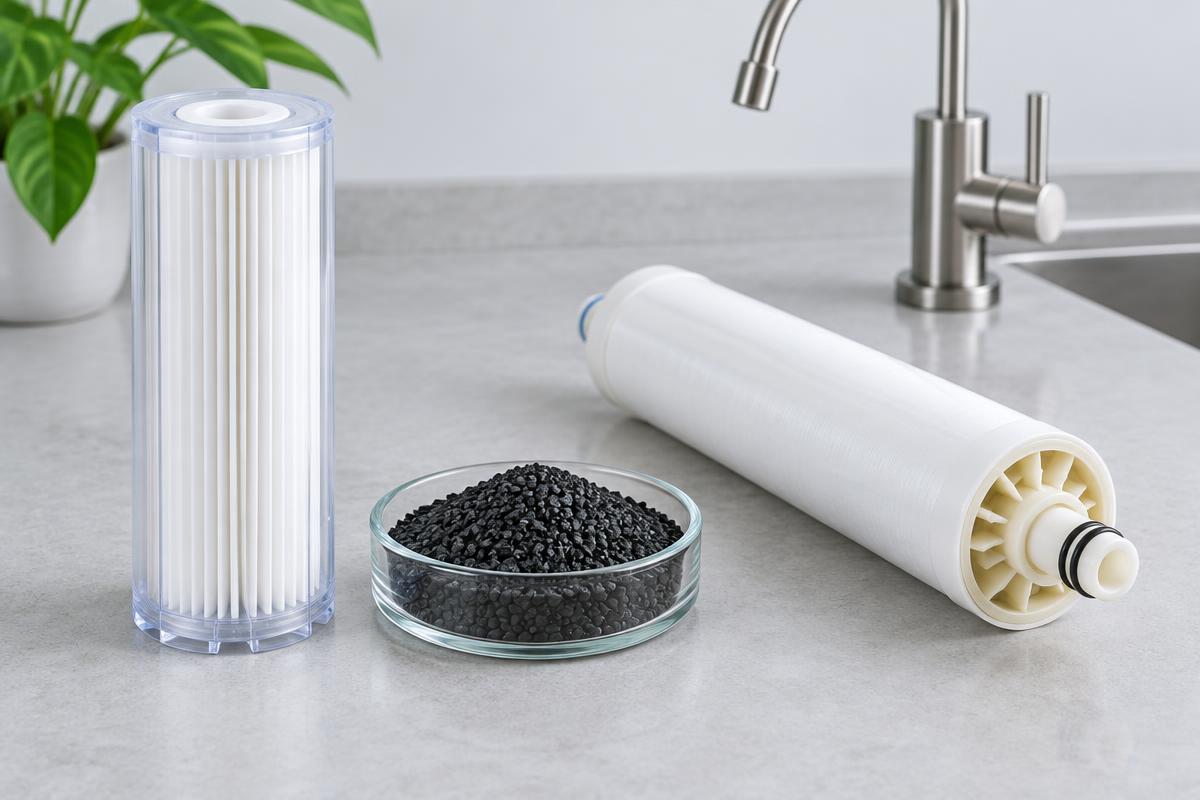
Carbon, a softener, reverse osmosis, and a salt-free conditioner are not interchangeable treatments. The table below separates their typical jobs and limits. A category name is not proof of product performance; ask for the exact model’s reduction claims, rated capacity, and service instructions.
For example, a homeowner who dislikes chlorine taste but has no scale concern may evaluate a different setup from a homeowner with a measured hardness problem. A well owner may need additional treatment based on laboratory results. Neither situation justifies promising that a generic filter makes every kind of water safe.
| Treatment | Main purpose | Important limit | Ongoing requirements |
|---|---|---|---|
| Whole-house carbon | Taste and odor; listed chemical reductions | Does not soften water | Media replacement; verify target and flow rating |
| Ion-exchange softener | Dissolved calcium and magnesium hardness | Not a general disinfectant or PFAS filter | Salt or potassium, regeneration water, servicing |
| Reverse osmosis | Specified dissolved contaminants at a treated faucet | A kitchen unit does not treat showers | Membrane service, cartridges, reject water |
| Salt-free conditioner | Scale management where supported by product testing | Not ion-exchange softening; minerals remain | Check water chemistry and manufacturer restrictions |
Sources:EPA home water treatment guideEPA consumer confidence reports
What does this mean for your house?
Translate the evidence into a specific household question before buying equipment. For appliances and the water heater, document scale, visible particles, maintenance history, and any measured hardness. For fixtures, distinguish an occasional mark from an ongoing change in the incoming supply. Photographs and dates can help a technician understand what changed, but they are not laboratory results.
For taste, record whether the change is at one tap or across the house, and whether the water is hot or cold. Preferences about skin and hair are personal and do not establish a contaminant diagnosis or a medical outcome. A water-treatment system should not be promised as a cure. Use the utility’s current instructions for a notice and a qualified clinician for health questions.
Set a practical goal that can be checked after any work. That may be a repeated hardness reading, a documented target-specific laboratory result, or an agreed maintenance plan. Clear goals make it easier to distinguish a useful improvement from a sales claim that cannot be verified.
Sources:EPA home water treatment guideEPA consumer confidence reports
How can I avoid a misleading water test or sales claim?
Ask for the raw result, units, method, sample date, and collection point. A demonstration that makes water change color is not a complete safety assessment. A low TDS value is not proof of contaminant-free water, and a hardness result cannot diagnose PFAS or bacteria. The measurement should answer the specific question you asked.
Separate a free in-home field assessment from specialized laboratory work. Ask which parameters are included and which need a separate analysis before a sample is taken. For a private well, use the laboratory or health department’s collection instructions because handling can affect whether the result is meaningful.
Before accepting a treatment proposal, ask for the exact model, documented reduction claim, rated operating conditions, and service requirements. A certification or test claim should apply to the product and target, not be used as a blanket claim about the company. If a fact is unknown, the honest next step is to obtain it rather than manufacture a regional average.
Sources:EPA home water treatment guideEPA consumer confidence reports
How do Orange County towns fit into this guide?
Orange County geography helps organize your search, but it does not collapse OUC, Orange County Utilities, and city systems into one report. Orlando, Apopka, Ocoee, Winter Garden, and Winter Park require confirmation at the actual property. An existing neighborhood page can help you find the local context while the water bill identifies the provider.
For example, a reader researching a whole home water filter in Apopka should not inherit an Orlando hardness reading simply because both are in the same county. A Winter Park homeowner should not assume the equipment selected for a Lake County well is appropriate. Use the system’s source description and household results to explain the difference.
When a local result is not available, keep that gap explicit. A useful guide can explain the question, the correct source, and the next step without publishing a false number. That approach is more informative than assigning every subdivision an unsupported claim about safety or required treatment.
Sources:Orange County Utilities water qualityEPA home water treatment guideEPA consumer confidence reports
What should Seminole County homeowners compare?
Seminole County’s published report distinguishes eleven service areas, and city providers require their own applicable information. Lake Mary, Sanford, and Oviedo are places to investigate, not interchangeable water samples. A report for one service area should stay labeled as that service area’s report.
The same principle applies to current events. PFAS litigation reporting and regulatory proposals provide context, but neither determines a particular home’s measured water quality. Follow the evidence back to the utility sampling record or a suitable household laboratory analysis before specifying contaminant treatment.
If you live on a private well, the county or city report does not represent your own source. Record the well’s test history and any recent repair, flooding, or change in use. A current property-specific record gives a treatment supplier a better basis for advice than a regional reputation.
Sources:Seminole County 2024 reportEPA home water treatment guideEPA consumer confidence reports
What should Lake County homeowners compare?
Lake County residents should first distinguish a public-system connection from a private well. Clermont, Eustis, and Mount Dora contain different property situations, so a town name alone is not enough. City utility customers need their serving system’s report; private-well owners need suitable testing for their own source.
The Lake County Water Quality Lab is a testing resource, not a single countywide drinking-water report. Florida Department of Health explains the owner’s well-testing responsibilities. If you need to investigate iron, sulfur-like odor, or sediment, ask which additional analyses are appropriate rather than assuming a bacteria result explains every complaint.
Installation also needs to account for the actual water supply and service conditions. Tell the supplier about well operation, household demand, access, and existing treatment. A written proposal should explain what each stage is intended to address and which unanswered questions remain outside its scope.
Sources:Lake County Water Quality LabEPA home water treatment guideEPA consumer confidence reports
How do I plan a treatment decision without overbuying?
Make a short list with three columns: documented condition, desired outcome, and evidence needed. A hardness reading and a goal of less scale belong together. A taste preference and a documented disinfectant-reduction claim can be evaluated together. A safety concern belongs with the correct analysis and relevant official guidance.
Next identify whether the goal is at one faucet or throughout the home. That decision prevents a kitchen device from being sold as shower treatment and prevents a whole-home installation from being justified only by a drinking-faucet preference. Ask the supplier to explain any additional stages in terms of the actual target.
Finally compare service requirements, not just purchase price. Replacement parts, regeneration, backwashing, cleaning, and access affect how the installation will be used. A simpler, well-maintained setup for a verified concern can be a better decision than a more complex package bought on unsupported claims.
Sources:EPA home water treatment guideEPA consumer confidence reports
Frequently asked
How do I check Central Florida water quality at my address?+
Match your address to the water supplier before interpreting a county or city report. The name on a water bill is a better starting point than an Orlando mailing address, a subdivision sign, or a nearby treatment plant. If the supplier buys water from another system, ask which report and service area apply.
What does OUC say about Orlando’s water source?+
OUC’s 2024 Water Quality Report identifies the Lower Floridan Aquifer as its source and describes ozone treatment. That is a statement about the OUC system and the report’s period, not proof that every home with an Orlando postal address receives OUC water.
How is Orange County Utilities different from OUC?+
Orange County Utilities is a separate provider with its own water-quality information. Its official page describes groundwater from the Floridan Aquifer and discusses disinfection and aeration. Do not copy an OUC result into an Orange County Utilities household report simply because both addresses are in Orange County.
Why do Seminole County reports list different service areas?+
Seminole County’s 2024 water-quality report separates information into eleven service areas. Read the section serving your property rather than selecting whichever table has the clearest number. City utilities and private wells elsewhere in Seminole County are not automatically covered by a county-operated system’s report.
Where do Lake County well owners find water information?+
A private well needs its own testing, not a city utility’s CCR. Lake County’s Water Quality Lab offers information about private-well sample analysis, and Florida Department of Health guidance explains the owner’s testing responsibility. Neither source supplies a measured hardness or iron level for every well in the county.
Does a free in-home field test include PFAS laboratory analysis?+
Do not assume that routine field readings include PFAS analysis. Ask which parameters are included and arrange specialized laboratory sampling when that is your concern. Hardness, chlorine, pH and TDS do not establish a PFAS result.
About Shield Water Solutions
Shield Water Solutions provides whole-home water filtration guidance and service in Orange, Seminole, and Lake County, Florida. This guide is educational and does not replace a utility notice, a laboratory result, or advice from your local health department.
Sources:OUC 2024 Water Quality ReportOrange County Utilities water qualitySeminole County 2024 reportLake County Water Quality LabFlorida Department of Health private wellsEPA home water treatment guideEPA consumer confidence reports