Water Softener vs Salt-Free Conditioner in Florida
A water softener and a salt-free conditioner are not the same treatment. Ion-exchange softening reduces dissolved calcium and magnesium, while a conditioner may target scale behavior without removing those minerals. Whole-house carbon addresses different concerns. In Florida, choose from measured water conditions, product-specific claims, and the maintenance you are prepared to perform.
Published November 7, 2026 · Shield Water Solutions
Last reviewed 2026-11-07 · By the Shield Water Solutions team
Quick facts
| Topic | What is known |
|---|---|
| Utility | Identify the supplier and service area from your water bill; a city name alone is not enough.EPA consumer confidence reports |
| Water source | Read the source description in the report for your actual system. Private wells need their own results.EPA consumer confidence reports |
| Treatment method | Utility treatment and household treatment serve different purposes; match any equipment to the documented concern.EPA home water treatment guide |
| Hardness | No address-specific reading is published here. Ask for a measured result with units.EPA home water treatment guide |
| Disinfectant | Confirm chlorine, chloramine, or other treatment in your provider’s report.EPA consumer confidence reports |
| PFAS status | Not inferred from taste, hardness, or a neighborhood name. Consult system-specific sampling and notices.EPA consumer confidence reports |
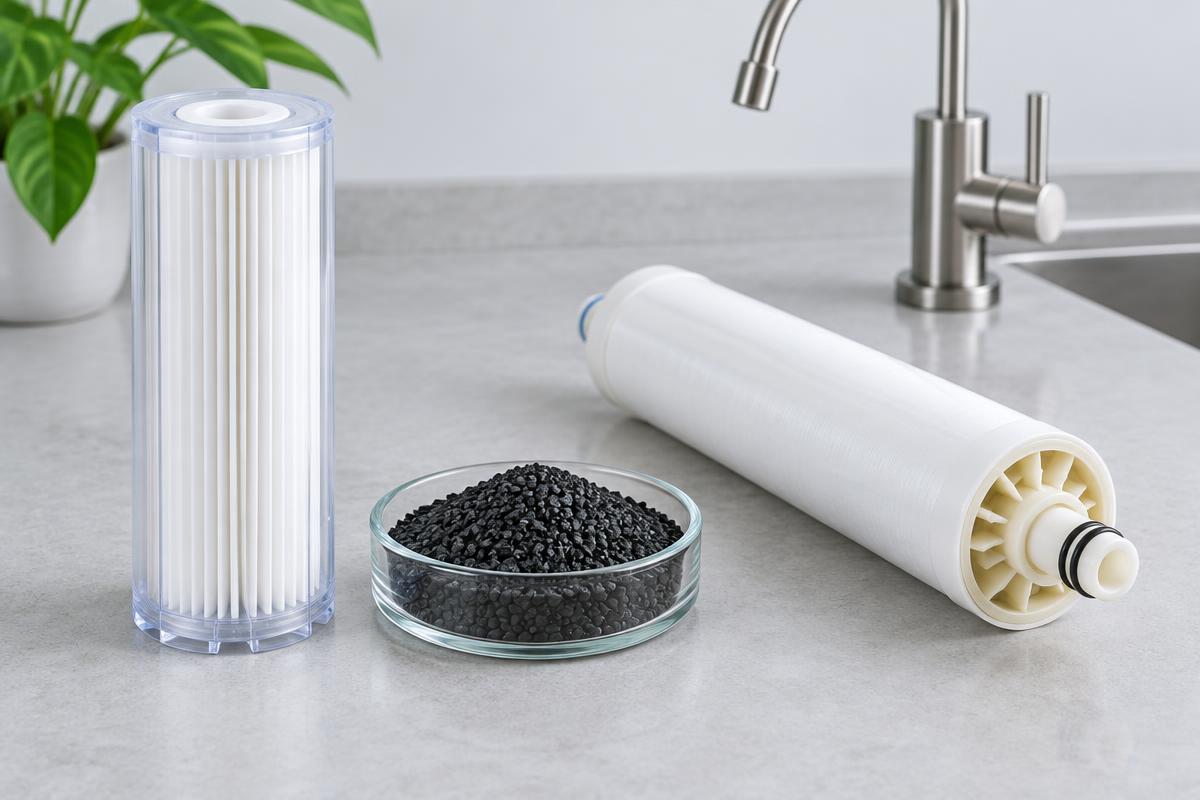
What changes with a water softener vs salt-free conditioner?
Ion-exchange softening changes dissolved hardness by exchanging calcium and magnesium ions. A salt-free scale-control product should not be assumed to provide that same result. Ask what the product actually claims and which test or listing supports it.
The phrase salt-free softener can blur an important distinction. If your goal is a lower hardness reading, request evidence of actual hardness reduction. If the goal is managing scale, ask how scale performance is documented and under what water conditions.
Sources:EPA water softener guideEPA home water treatment guideEPA consumer confidence reports
Does a whole-house carbon filter replace a softener?
No, carbon filtration and hardness softening have different purposes. Carbon products are often evaluated for taste, odor, and specified chemical reductions. Ion-exchange resin is used for hardness reduction. A system covering all taps still needs the correct technology for the intended target.
The right comparison begins with your untreated results. A homeowner with only a taste complaint may not need the same arrangement as a homeowner documenting hardness and scale. Avoid buying a combination simply because more equipment sounds more complete.
Sources:EPA water softener guideEPA home water treatment guideEPA consumer confidence reports
What maintenance does each option require?
A regenerating softener needs the correct regenerant, settings, and operational checks. EPA’s water softener guide discusses water use and brine as well as the benefits of softening. A conditioner may have different service requirements, so read the actual manual rather than assuming no salt means no maintenance.
Carbon and RO stages add their own replacement schedules. Ask for the recurring supplies, water use, access requirements, and servicing responsibilities for each proposed setup. The cheapest initial device is not necessarily the easiest arrangement to maintain.
Sources:EPA home water treatment guideEPA consumer confidence reports
Will a conditioner improve soap lather like soft water?
Do not assume a scale-control claim includes all the practical effects of removing hardness minerals. EPA describes hardness-related cleaning and residue issues, but a particular conditioner’s performance must be established separately. Ask the supplier to distinguish a measurable hardness change from a scale-management claim.
Preferences about washing feel, dishes, skin, and hair differ between households. None should be turned into a medical promise. Define the outcome you want, then ask what the proposed device can and cannot support.
Sources:EPA home water treatment guideEPA consumer confidence reports
How should Florida homeowners compare proposals?
Compare the target, documented performance, operating conditions, and maintenance side by side. Include actual water chemistry and household demand, not just a model name or regional reputation. The table below is a category overview rather than a certification of any Shield product.
Request model-specific evidence and a written scope before deciding. If testing shows no relevant issue, there may be no reason to buy an additional stage. If a safety concern is documented, select treatment for that specific finding instead of relying on a generic scale-control device.
Sources:EPA home water treatment guideEPA consumer confidence reports
Which treatment does what for a Central Florida home?
Carbon, a softener, reverse osmosis, and a salt-free conditioner are not interchangeable treatments. The table below separates their typical jobs and limits. A category name is not proof of product performance; ask for the exact model’s reduction claims, rated capacity, and service instructions.
For example, a homeowner who dislikes chlorine taste but has no scale concern may evaluate a different setup from a homeowner with a measured hardness problem. A well owner may need additional treatment based on laboratory results. Neither situation justifies promising that a generic filter makes every kind of water safe.
| Treatment | Main purpose | Important limit | Ongoing requirements |
|---|---|---|---|
| Whole-house carbon | Taste and odor; listed chemical reductions | Does not soften water | Media replacement; verify target and flow rating |
| Ion-exchange softener | Dissolved calcium and magnesium hardness | Not a general disinfectant or PFAS filter | Salt or potassium, regeneration water, servicing |
| Reverse osmosis | Specified dissolved contaminants at a treated faucet | A kitchen unit does not treat showers | Membrane service, cartridges, reject water |
| Salt-free conditioner | Scale management where supported by product testing | Not ion-exchange softening; minerals remain | Check water chemistry and manufacturer restrictions |
Sources:EPA home water treatment guideEPA consumer confidence reports
What does this mean for your house?
Translate the evidence into a specific household question before buying equipment. For appliances and the water heater, document scale, visible particles, maintenance history, and any measured hardness. For fixtures, distinguish an occasional mark from an ongoing change in the incoming supply. Photographs and dates can help a technician understand what changed, but they are not laboratory results.
For taste, record whether the change is at one tap or across the house, and whether the water is hot or cold. Preferences about skin and hair are personal and do not establish a contaminant diagnosis or a medical outcome. A water-treatment system should not be promised as a cure. Use the utility’s current instructions for a notice and a qualified clinician for health questions.
Set a practical goal that can be checked after any work. That may be a repeated hardness reading, a documented target-specific laboratory result, or an agreed maintenance plan. Clear goals make it easier to distinguish a useful improvement from a sales claim that cannot be verified.
Sources:EPA home water treatment guideEPA consumer confidence reports
How can I avoid a misleading water test or sales claim?
Ask for the raw result, units, method, sample date, and collection point. A demonstration that makes water change color is not a complete safety assessment. A low TDS value is not proof of contaminant-free water, and a hardness result cannot diagnose PFAS or bacteria. The measurement should answer the specific question you asked.
Separate a free in-home field assessment from specialized laboratory work. Ask which parameters are included and which need a separate analysis before a sample is taken. For a private well, use the laboratory or health department’s collection instructions because handling can affect whether the result is meaningful.
Before accepting a treatment proposal, ask for the exact model, documented reduction claim, rated operating conditions, and service requirements. A certification or test claim should apply to the product and target, not be used as a blanket claim about the company. If a fact is unknown, the honest next step is to obtain it rather than manufacture a regional average.
Sources:EPA home water treatment guideEPA consumer confidence reports
Frequently asked
What changes with a water softener vs salt-free conditioner?+
Ion-exchange softening changes dissolved hardness by exchanging calcium and magnesium ions. A salt-free scale-control product should not be assumed to provide that same result. Ask what the product actually claims and which test or listing supports it.
Does a whole-house carbon filter replace a softener?+
No, carbon filtration and hardness softening have different purposes. Carbon products are often evaluated for taste, odor, and specified chemical reductions. Ion-exchange resin is used for hardness reduction. A system covering all taps still needs the correct technology for the intended target.
What maintenance does each option require?+
A regenerating softener needs the correct regenerant, settings, and operational checks. EPA’s water softener guide discusses water use and brine as well as the benefits of softening. A conditioner may have different service requirements, so read the actual manual rather than assuming no salt means no maintenance.
Will a conditioner improve soap lather like soft water?+
Do not assume a scale-control claim includes all the practical effects of removing hardness minerals. EPA describes hardness-related cleaning and residue issues, but a particular conditioner’s performance must be established separately. Ask the supplier to distinguish a measurable hardness change from a scale-management claim.
How should Florida homeowners compare proposals?+
Compare the target, documented performance, operating conditions, and maintenance side by side. Include actual water chemistry and household demand, not just a model name or regional reputation. The table below is a category overview rather than a certification of any Shield product.
Does a free in-home field test include PFAS laboratory analysis?+
Do not assume that routine field readings include PFAS analysis. Ask which parameters are included and arrange specialized laboratory sampling when that is your concern. Hardness, chlorine, pH and TDS do not establish a PFAS result.
About Shield Water Solutions
Shield Water Solutions provides whole-home water filtration guidance and service in Orange, Seminole, and Lake County, Florida. This guide is educational and does not replace a utility notice, a laboratory result, or advice from your local health department.
Sources:EPA water softener guideEPA home water treatment guideCDC home water treatment systemsEPA consumer confidence reports