Well Water Lake County: Iron, Sulfur and Sediment
Well water in Lake County needs property-specific testing because a municipal report does not describe your private well. Iron stains, sulfur-like odor, and sediment can suggest different treatment questions, but none establishes a complete safety result. Start with Florida health-department testing guidance and the laboratory’s sampling instructions before selecting a treatment train.
Published November 7, 2026 · Shield Water Solutions
Last reviewed 2026-11-07 · By the Shield Water Solutions team
Quick facts
| Topic | What is known |
|---|---|
| Utility | Identify the supplier and service area from your water bill; a city name alone is not enough.EPA consumer confidence reports |
| Water source | Read the source description in the report for your actual system. Private wells need their own results.EPA consumer confidence reports |
| Treatment method | Utility treatment and household treatment serve different purposes; match any equipment to the documented concern.EPA home water treatment guide |
| Hardness | No address-specific reading is published here. Ask for a measured result with units.EPA home water treatment guide |
| Disinfectant | Confirm chlorine, chloramine, or other treatment in your provider’s report.EPA consumer confidence reports |
| PFAS status | Not inferred from taste, hardness, or a neighborhood name. Consult system-specific sampling and notices.EPA consumer confidence reports |
Who is responsible for testing well water in Lake County?
The private-well owner is responsible for arranging appropriate testing. Florida Department of Health recommends routine testing for bacteria and nitrate at least annually, and provides guidance for additional circumstances. Lake County’s Water Quality Lab also describes private-well sample analysis.
A neighbor’s report or an old clean result does not establish the condition of your well today. Keep the sample date, collection point, laboratory report, and any relevant well work together. This record is useful when comparing results after a repair or treatment change.
Sources:Florida Department of Health private wellsLake County Water Quality LabEPA home water treatment guideEPA consumer confidence reports
Do orange stains prove my well has an iron problem?
Orange staining is a reason to investigate, not a measured iron concentration. Ask for appropriate analysis and distinguish dissolved material from visible particles. Manganese, plumbing condition, and other factors may also matter to the treatment design.
Do not assign an iron level to Clermont, Eustis, Mount Dora, or a rural neighborhood without a relevant source. Even nearby wells can need their own sampling. A treatment recommendation should identify what was measured and which operating conditions it assumes.
Sources:Florida Department of Health private wellsEPA home water treatment guideEPA consumer confidence reports
How should I investigate sulfur odor and sediment?
Record odor and particle observations separately because they need not share a cause. A sulfur-like smell does not diagnose the chemistry, and visible sediment does not identify bacteria. Check hot and cold water, the incoming supply, and any recent pump or plumbing work.
A sediment filter may intercept particles but is not a complete well-safety system. A device selected for odor does not automatically reduce all dissolved contaminants. Arrange the analysis that matches the concern and confirm whether additional safety testing is needed.
Sources:EPA home water treatment guideEPA consumer confidence reports
Does a softener solve every well-water concern?
No, a softener’s primary job is reducing hardness minerals. It should not be presented as general protection against bacteria, all iron conditions, or PFAS. Whether a particular unit can handle additional chemistry depends on the model and its documented operating limits.
Ask whether pretreatment, a separate contaminant-specific stage, or disinfection is warranted by the results. Do not treat a standard sequence of tanks as a universal Lake County specification. The chemistry, water demand, and well’s operating capacity need to support the design.
Sources:Florida Department of Health private wellsEPA home water treatment guideEPA consumer confidence reports
What should I do after flooding or well service?
Follow health-department guidance about testing and precautions after events that may affect the well. A clear appearance does not prove the water is safe. Tell the testing service what happened and follow its collection instructions so the result answers the relevant question.
If testing indicates a problem, get guidance about corrective action and retesting. Reducing stains or smell is not enough to verify a safety correction. Keep results from before and after the work so the conclusion rests on evidence rather than appearance.
Sources:Florida Department of Health private wellsEPA home water treatment guideEPA consumer confidence reports
Which treatment does what for a Central Florida home?
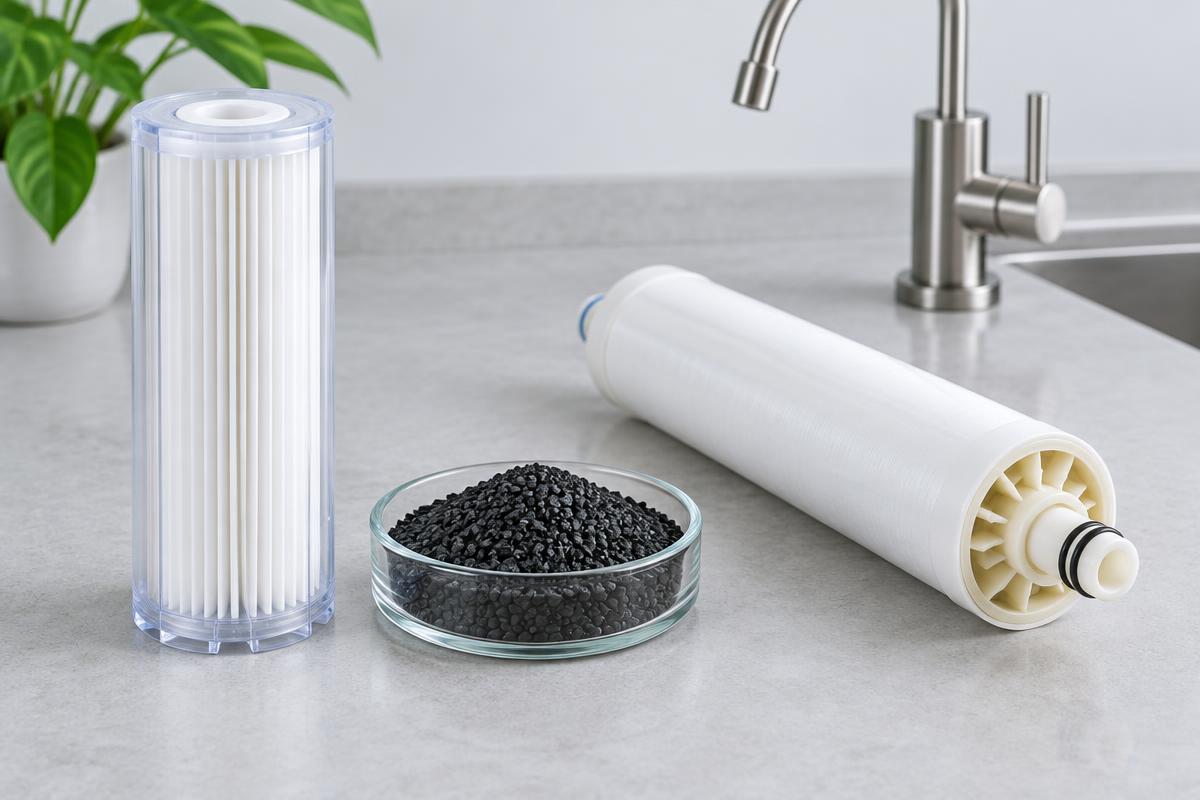
Carbon, a softener, reverse osmosis, and a salt-free conditioner are not interchangeable treatments. The table below separates their typical jobs and limits. A category name is not proof of product performance; ask for the exact model’s reduction claims, rated capacity, and service instructions.
For example, a homeowner who dislikes chlorine taste but has no scale concern may evaluate a different setup from a homeowner with a measured hardness problem. A well owner may need additional treatment based on laboratory results. Neither situation justifies promising that a generic filter makes every kind of water safe.
| Treatment | Main purpose | Important limit | Ongoing requirements |
|---|---|---|---|
| Whole-house carbon | Taste and odor; listed chemical reductions | Does not soften water | Media replacement; verify target and flow rating |
| Ion-exchange softener | Dissolved calcium and magnesium hardness | Not a general disinfectant or PFAS filter | Salt or potassium, regeneration water, servicing |
| Reverse osmosis | Specified dissolved contaminants at a treated faucet | A kitchen unit does not treat showers | Membrane service, cartridges, reject water |
| Salt-free conditioner | Scale management where supported by product testing | Not ion-exchange softening; minerals remain | Check water chemistry and manufacturer restrictions |
Sources:EPA home water treatment guideEPA consumer confidence reports
What does this mean for your house?
Translate the evidence into a specific household question before buying equipment. For appliances and the water heater, document scale, visible particles, maintenance history, and any measured hardness. For fixtures, distinguish an occasional mark from an ongoing change in the incoming supply. Photographs and dates can help a technician understand what changed, but they are not laboratory results.
For taste, record whether the change is at one tap or across the house, and whether the water is hot or cold. Preferences about skin and hair are personal and do not establish a contaminant diagnosis or a medical outcome. A water-treatment system should not be promised as a cure. Use the utility’s current instructions for a notice and a qualified clinician for health questions.
Set a practical goal that can be checked after any work. That may be a repeated hardness reading, a documented target-specific laboratory result, or an agreed maintenance plan. Clear goals make it easier to distinguish a useful improvement from a sales claim that cannot be verified.
Sources:EPA home water treatment guideEPA consumer confidence reports
How can I avoid a misleading water test or sales claim?
Ask for the raw result, units, method, sample date, and collection point. A demonstration that makes water change color is not a complete safety assessment. A low TDS value is not proof of contaminant-free water, and a hardness result cannot diagnose PFAS or bacteria. The measurement should answer the specific question you asked.
Separate a free in-home field assessment from specialized laboratory work. Ask which parameters are included and which need a separate analysis before a sample is taken. For a private well, use the laboratory or health department’s collection instructions because handling can affect whether the result is meaningful.
Before accepting a treatment proposal, ask for the exact model, documented reduction claim, rated operating conditions, and service requirements. A certification or test claim should apply to the product and target, not be used as a blanket claim about the company. If a fact is unknown, the honest next step is to obtain it rather than manufacture a regional average.
Sources:EPA home water treatment guideEPA consumer confidence reports
Frequently asked
Who is responsible for testing well water in Lake County?+
The private-well owner is responsible for arranging appropriate testing. Florida Department of Health recommends routine testing for bacteria and nitrate at least annually, and provides guidance for additional circumstances. Lake County’s Water Quality Lab also describes private-well sample analysis.
Do orange stains prove my well has an iron problem?+
Orange staining is a reason to investigate, not a measured iron concentration. Ask for appropriate analysis and distinguish dissolved material from visible particles. Manganese, plumbing condition, and other factors may also matter to the treatment design.
How should I investigate sulfur odor and sediment?+
Record odor and particle observations separately because they need not share a cause. A sulfur-like smell does not diagnose the chemistry, and visible sediment does not identify bacteria. Check hot and cold water, the incoming supply, and any recent pump or plumbing work.
Does a softener solve every well-water concern?+
No, a softener’s primary job is reducing hardness minerals. It should not be presented as general protection against bacteria, all iron conditions, or PFAS. Whether a particular unit can handle additional chemistry depends on the model and its documented operating limits.
What should I do after flooding or well service?+
Follow health-department guidance about testing and precautions after events that may affect the well. A clear appearance does not prove the water is safe. Tell the testing service what happened and follow its collection instructions so the result answers the relevant question.
Does a free in-home field test include PFAS laboratory analysis?+
Do not assume that routine field readings include PFAS analysis. Ask which parameters are included and arrange specialized laboratory sampling when that is your concern. Hardness, chlorine, pH and TDS do not establish a PFAS result.
About Shield Water Solutions
Shield Water Solutions provides whole-home water filtration guidance and service in Orange, Seminole, and Lake County, Florida. This guide is educational and does not replace a utility notice, a laboratory result, or advice from your local health department.
Sources:Florida Department of Health private wellsLake County Water Quality LabEPA home water treatment guideCDC home water treatment systemsEPA consumer confidence reports